3.5. TLS Certificate Installation
>Settings\System\TLS
Instead of using the self-signed TLS certificate which comes pre-installed on your Analysis Cockpit, you should consider using your own TLS certificate. This will avoid browser warnings when navigating to your Analysis Cockpit's web interface.
You can click Generate CSR to open the following modal which
lets you specify the information needed for the CSR.
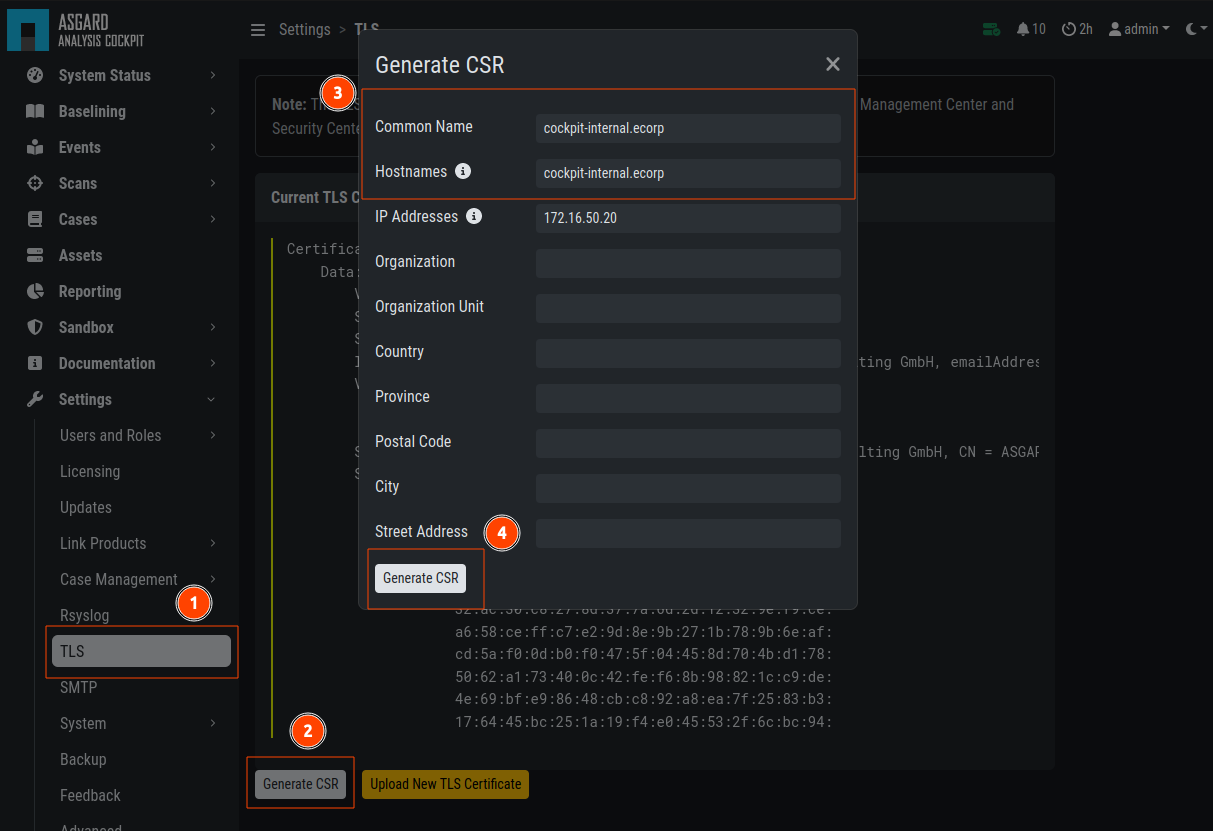
Generate a Certificate Signing Request (CSR)
Hint
In order to achieve the best possible compatibility with most browsers, we
recommend using the system's FQDN in both fields Common Name AND Hostnames.
The generated CSR can be used to generate a TLS certificate via your Certificate Authority. The resulting TLS certificate can then be uploaded in the in the same section of your Analysis Cockpit.
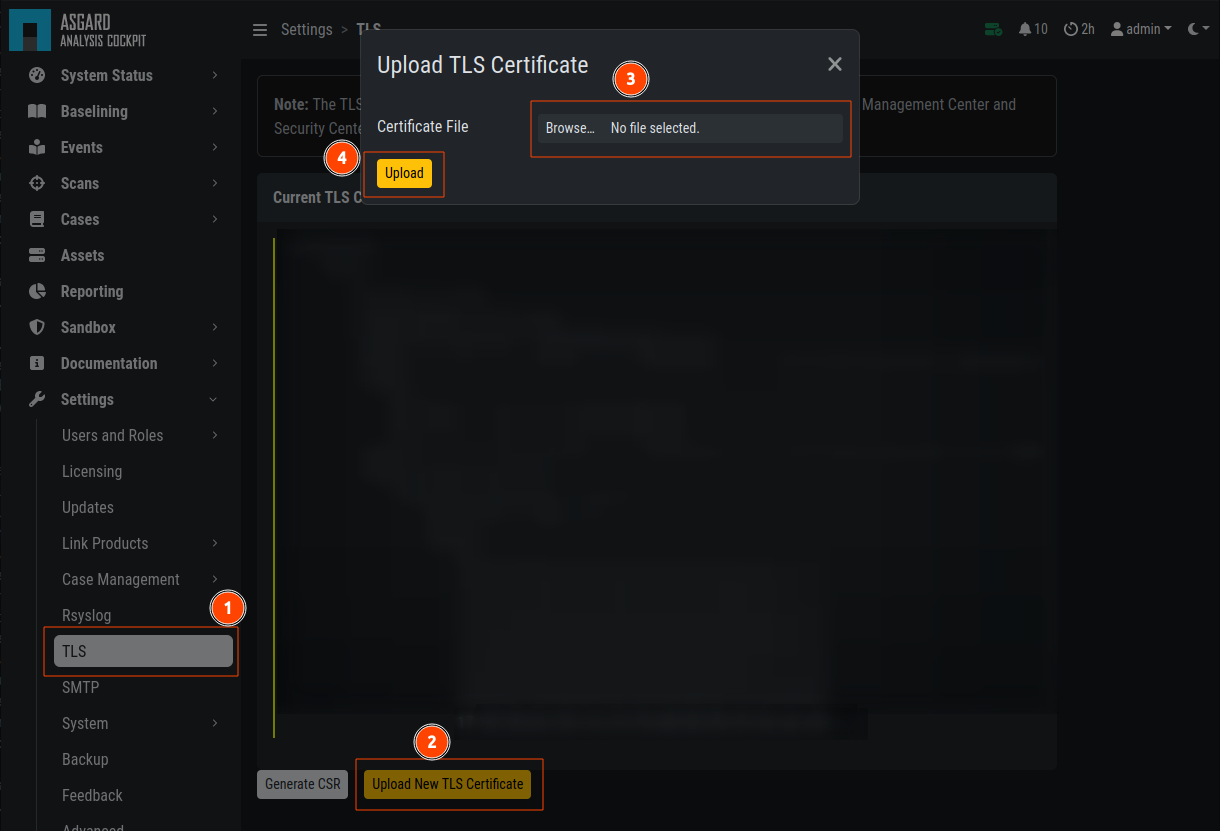
Upload a TLS Certificate
3.6. Configure LDAP
>Settings\Users and Roles\LDAP
This section lets you configure a remote LDAP server to integrate with your Analysis Cockpit. This lets you use existing LDAP/Windows Domain users to log into the Analysis Cockpit, as well as define mappings between LDAP groups and roles within the Analysis Cockpit.

Configure LDAP

Configure LDAP
3.7. Cockpit Notifications
>Settings\Case Management\Notifications
You can define custom notifications for the following types:
Case Intelligence Match
Case Intelligence Notifications are triggered when incoming events match a template for the first time. You can configure what kind of suggested cases trigger a notification, based on the case's type.
Case Change
Case Change Notifications are triggered when a new case is created or an existing case is updated. You can configure what kind of cases trigger a notification, based on the case's status or type.
Unassigned Event
Unassigned Event Notifications are triggered when newly incoming events are not automatically assigned to existing cases. You can configure what kind of events trigger a notification, based on the event's level or score.
Event Assignment
Event Assignment Notifications are triggered when newly incoming events are automatically assigned to existing cases. You can configure what kind of cases trigger a notification, based on the case's status or type.
New Asset Affected
Asset Affected Notifications are triggered when an asset is affected by a case for the first time. You can configure what kind of cases trigger a notification, based on the case's status or type.
The notification targets can be the following:
Application (This shows a notification in the Analysis Cockpit)
Syslog
Email (SMTP has to be configured to use this)
Webhook
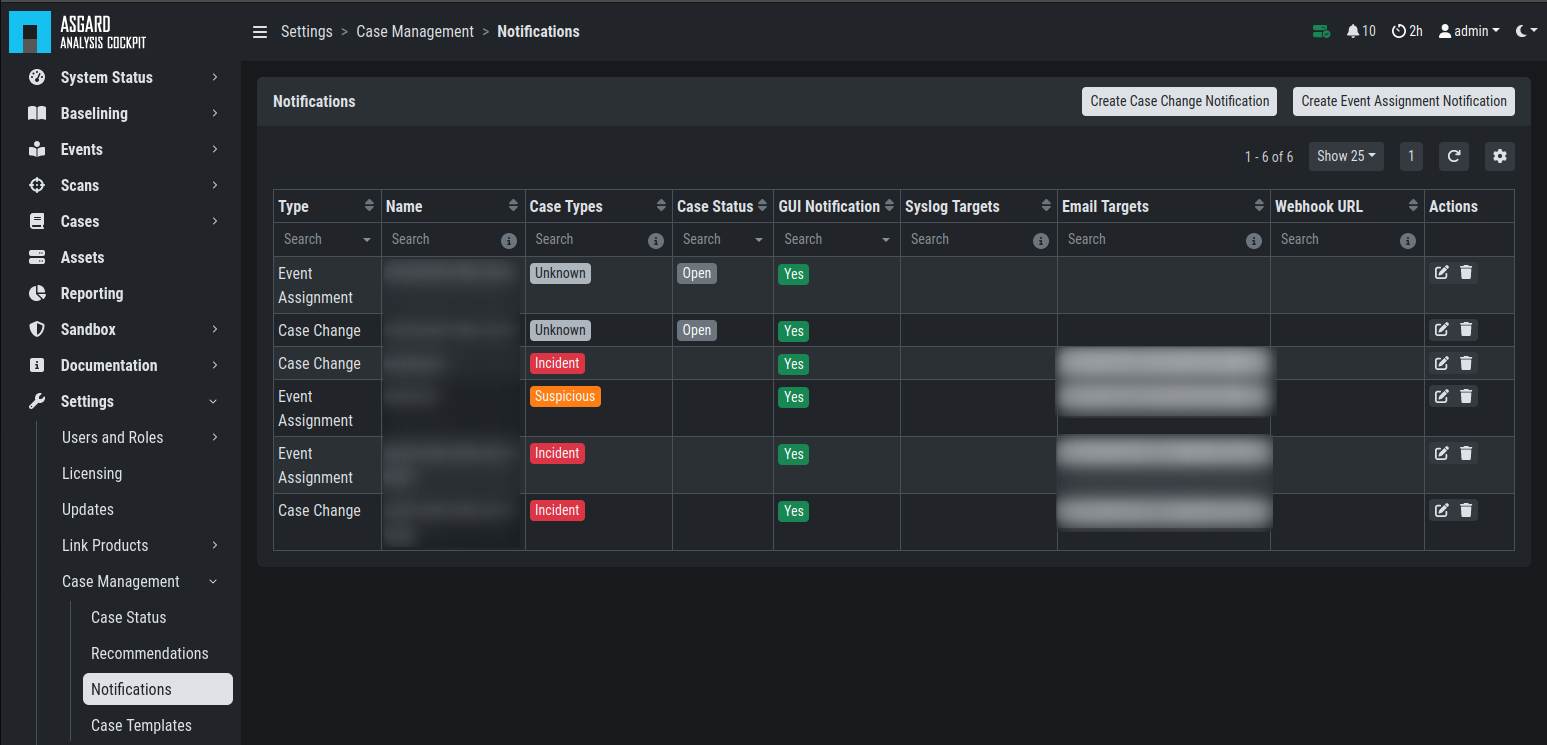
Case Management - Notifications
Note
The Analysis Cockpit will collect all triggering events and send only one email every 15 minutes. Syslog and Webhooks are triggered in real time for every single event.
Below you can see how Application Notifications look like. You can see
the bell icon in the top right corner and view all unread notifications
by clicking the icon. Unread notifications can be Acknowledged by
selecting one or more notification and clicking Acknowledge. The
notification bell in the status bar will only show an indicator if you
have unread notifications.

UI Notification Bell

UI Notifications
It is recommended to configure an Event Assignment Notification for events that get added to existing Incident cases.
3.7.1. Configure Notifications
>Settings\Case Management\Notifications
To configure notifications, click the Create Notification button.
This leads you to a form that allows you to set a name for your
notification, the notification type (syslog, email, webhook or notification
within the Analysis Cockpit) and the condition that will trigger your notification.

Example Notification Creation
You can have multiple Notifications, also of the same type.